What is gamification?
Gamification means using game elements such as points, levels, badges and leaderboards to make a task or message more engaging. It works when the task already has a reason to exist. It fails when it is a coat of paint.
 AI visualisation
If you have searched for the gamification meaning, you have probably seen two answers. One says it will transform your business. The other says it is a gimmick. Both are lazy. This guide asks what is gamification in plain terms, which parts work, and how to tell whether your project should use it at all.
What is gamification? The meaning
Gamification means taking parts of games and applying them to something that is not a game. A coffee card with a stamp for each cup is gamification. So is a streak in a language app, or a progress bar on a training course.
It is different from a game. A game is played for its own sake. Gamification adds game parts to a task that already exists. A branded game sits between the two: a real game, made to carry a message or prompt one action. We build both, and it helps to know which one you are asking for. Our branded games and gamification page shows the difference.
Gamification elements, and what each one does
Each element has one job. Pick by the job, not by the list.
| Element | What it does | Where it goes wrong |
|---|---|---|
| Points | Give a small reward for each action | People do the easy action only |
| Levels | Show progress over time | They stall if the climb is too steep |
| Gamification badges | Mark an achievement | They mean nothing if everyone gets them |
| Leaderboards | Add comparison and rivalry | The bottom half quits |
| Streaks | Build a daily habit | One missed day can end the habit |
| Challenges | Give a clear goal with an end | They feel like homework without a reason |
| Teams | Add belonging and shared stakes | One strong player carries the rest |
| Feedback | Tell people at once how they did | Too much becomes noise |
The last row matters most. Fast, clear feedback does more for a task than any badge.
Motivation, without overclaiming
You will read that gamification raises engagement by a large percentage. Be careful with any such figure. Ask who measured it, against what, and for how long. The evidence on points and badges is mixed, and much depends on the task and the person. We do not publish uplift numbers, and you should ask hard questions of anyone who does.
Here is what we think is fair to say, as guidance and not as a law.
- Clear goals help. People do better when they can see what done looks like.
- Feedback helps. Knowing how you did makes you more likely to try again.
- Novelty fades. The first week of a points system tells you little. Watch week four.
- Rewards can backfire. Pay people in points for something they enjoyed anyway, and it can start to feel like work.
- Choice matters. A task people choose feels different from the same task made compulsory, however many badges it holds.
A useful check from motivation research is to ask three things. Does this give people a real choice? Does it help them feel more able? Does it connect them with others? If the answer to all three is no, the points will not rescue it.
Gamification examples in marketing
In marketing, gamification earns attention and asks for one action in return. Some typical examples:
- A quiz that recommends the right product.
- A persona quiz people want to share.
- A web mini-game tied to a campaign, with a prize for taking part.
- A loyalty scheme with levels, so regulars can see what is next.
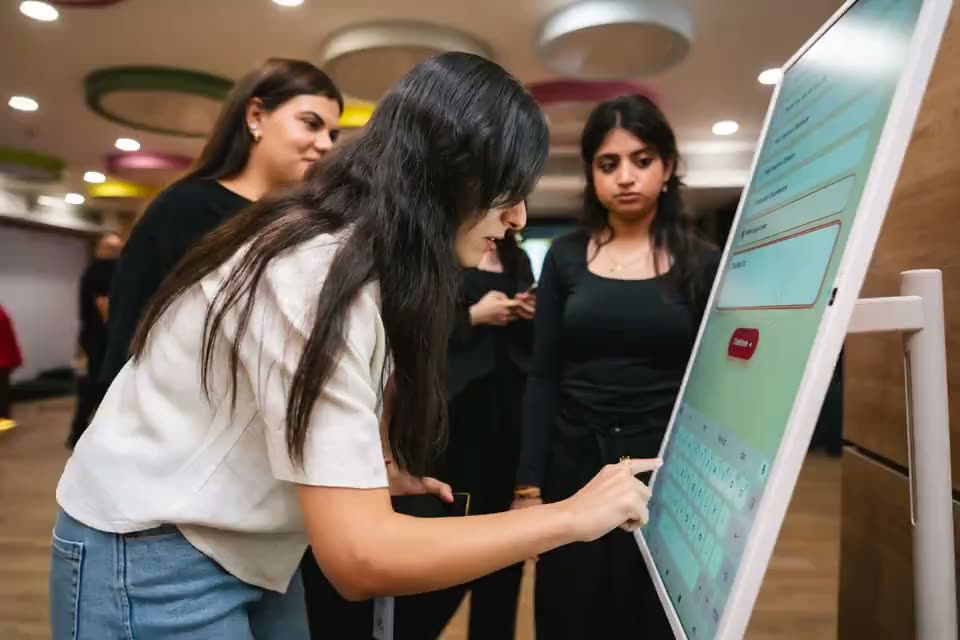
- A mixed game that joins a phone or a screen with something physical at an event.
The test is simple. Name the one action you want. Sign up, try the product, visit a store, learn one fact. If you cannot name it, you have a game with no job. We also avoid gambling mechanics, such as paid spins or chance-based rewards, and we suggest you do the same. In Saudi Arabia and Egypt they raise questions you do not want to answer in public.
When not to use gamification
Gamification is a bad fit when:
- The task has no reason to exist. Points on a pointless form make a pointless form with points.
- The stakes are serious. Medical choices, complaints and bad news do not need a badge.
- The real problem is elsewhere. If people avoid a process because it is broken, fix the process first.
- There is nobody to run it. Live systems need content, moderation and someone to answer when it breaks.
- It would feel like a trick. If your audience would be annoyed to see how it works, do not build it.
A plain test: would people do this task if it were simple and clear, with no game at all? If yes, the game may lift it. If no, a game will not save it, and people will resent the attempt.
Measuring gamification
Decide what you will count before you build. Game analytics record plays, completions and scores. What is collected, and who can see it, is agreed in the brief.
Start with these:
- Plays and unique players. How many people tried it?
- Completion. How many reached the end, and where did the rest stop?
- Return rate. Did anyone come back?
- The one action. Did players do the thing you built it for? Compare that with a group who did not play, if you can.
Plays alone flatter a project. The one action is the number that pays for it. We go through this in detail in how to measure a branded game.
What is gamification, in practice
What is the difference between gamification and a branded game?
Gamification adds game parts to an existing task, such as a stamp card. A branded game is a full game made to carry a message. Choose gamification when the task already exists, and a game when you need to create attention.
Do gamification badges work?
Sometimes. They work when they mark something people are proud of and others can see. They fail when they are handed out for everything.
Is gamification only for young audiences?
No. Stamp cards and frequent flyer levels are gamification, and they are not aimed at the young. Match the style to the audience, and keep the instructions short.
What does it take to start?
One clear action, one audience, and someone who owns the results. Bring those three to us on WhatsApp and we can tell you if a game is the right answer.