AI and live action in one film: how to choose, scene by scene
Most scenes can be sorted in minutes. List every scene, then mark it must be real, can be generated, or either. Real people saying real things should be filmed. Places you cannot shoot can be generated. Then price the "either" scenes both ways.
 Made with AI
AI and live action video: the question to ask
The useful question is rarely "AI or not". It is which parts of this film need a camera, and which do not. AI and live action video work well together when that choice is made scene by scene, before the budget is set.
We make AI films. Live action comes in as an element: footage you already own, or a short shoot for the scenes that have to be real. If you are still choosing between the two approaches, start with AI video vs traditional production. This article is for the next step, when you have a script and want to sort it.
 Made with AI
When to film and when to generate
Three marks are enough.
Must be real. The truth of the scene is the point.
- Real people saying real things: founders, customers, employees.
- Live moments: events, matches, launches.
- Exact details a viewer can check, when a generated version would not hold up.
Can be generated. Nobody watches this scene as evidence.
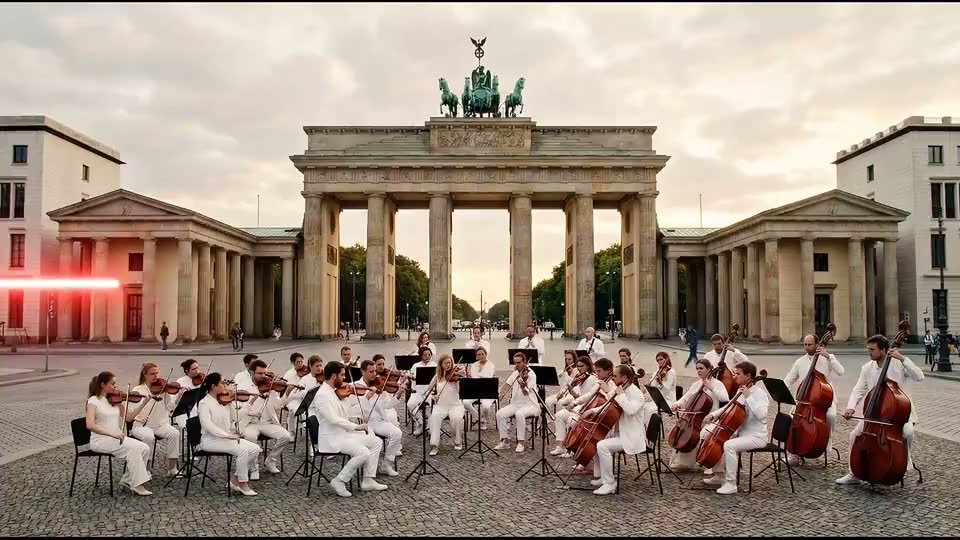
- Places you cannot easily shoot: a skyline at the perfect blue hour, or a building that does not exist yet.
- Moments in the past or the future.
- Scenes that need many versions for different seasons, markets or formats.
Either. Both routes would work, so let budget and control decide. A street scene with no named person is the usual example.
One test settles most arguments. Ask what a viewer would feel if they learned how this shot was made. If they would feel misled, it must be real, or the scene must change.
A worked 8-scene script
Here is an invented 60-second launch film for an invented juice brand. It is an example of the method, not a project of ours.
| # | Scene | Mark | Why |
|---|---|---|---|
| 1 | The city at blue hour, wide | Can be generated | Mood, and no fact to check |
| 2 | A street stall at dusk, people passing | Either | Compare both budgets |
| 3 | The founder explains why she started | Must be real | Real person, real words |
| 4 | Fruit harvested at dawn, long ago | Can be generated | A past nobody filmed |
| 5 | The bottle and label, close | Must be real | The label has to match the shelf |
| 6 | A customer says what she thinks | Must be real | A testimonial has to be true |
| 7 | The crowd at the launch | Must be real | It claims this happened |
| 8 | The bottle in an imagined city | Can be generated | Clearly a world, not a record |
The sort took a few minutes, and it already gives you a plan. Scenes 3, 5, 6 and 7 can go on one shot list. Some of that footage may already exist, which is worth checking first. Scenes 1, 4 and 8 go to generation. Scene 5 could also work as an exact product shot made from good references, if the close-up passes a side-by-side check against the real bottle.
Scene 2 is the one to price both ways. It is also where a director's opinion is useful. A generated stall gives more control over light. A filmed stall may feel more alive beside the real scenes around it.
Hybrid video production: what it does to the budget
A shoot is a separate line, not a small addition. Crew, location, permits and the day itself sit on top of the AI work. Client footage you already own is a much smaller line, because it only needs preparing for the edit.
A cinematic 60-second brand film with a half-day shoot, a human voice, lip-sync, original music and a script written for you plans at SAR 14,500 to 23,500 (USD 3,900 to 6,300) Calculator estimate, before VAT. Take the shoot out in the budget calculator and see how far the range moves. Try client footage as well. That comparison is what the "either" column is for.
Two costs are easy to miss:
- Matching. Filmed and generated shots have to sit in one film. Colour, grain and lens feel need planning before the shoot, not after.
- Sound. Real interviews bring real room sound, and generated scenes bring none. Sound design has to join the two.
AI video with real footage: making the cuts hold
The edit decides what the audience trusts. A few habits help.
Show the look to whoever is shooting before the shoot. Style frames can fix light and colour for both halves of the film. Film references for the generated scenes while the camera is out, such as product angles and textures. Keep a generated scene and a real testimony clearly apart, so one never borrows truth from the other.
AI brand films are often built this way, with a real interview and generated scenes that show the vision. Event films often run the other way round, with real crowd footage opened and closed by generated scenes.
How the audience should be told
Honest labelling is easier when you plan it with the script. Viewers should be able to tell what is a record and what is made.
Here is what we hold ourselves to, and you can check each one:
- Every AI film is labelled.
- AI people are never presented as real testimonials.
- A person approves every frame.
In a hybrid film, one label at the end may not be enough. If a film moves between a real speaker and generated scenes, make the change clear in the picture, in the words or in a caption. A line such as "Scenes made with AI" can sit beside the moments that need it. Check each platform's rules and each market's rules too, since they differ and they change. Our AI disclosure page says how we label our films.
The market is already moving
This is no longer theory in the region. On 5 March 2026, Enterprise reported on AI use in Egyptian TV and advertising production, including storyboards that let clients preview visuals before committing spend. One agency head told Enterprise, "It's a draft, not a final product." That matches our view. The tool makes the option. A person decides whether it stays.
The checklist
- List every scene in the script.
- Mark each one: must be real, can be generated, or either.
- Check which real footage you already own.
- Price the "either" scenes both ways.
- Plan the look across both halves before anyone shoots.
- Label the finished film honestly.
AI and live action questions
Can AI scenes match footage we already shot?
Often, yes. Send the footage early, so the style frames are built to match it. Very low quality or very different footage may need a colour and texture pass first.
Should a founder interview ever be generated?
We recommend filming it. An interview is valuable because a real person said it. A generated stand-in presented as the founder's own testimony would mislead viewers.
Do we need a shoot for a hybrid film?
Not always. A hybrid film can use existing footage, product shots or event coverage. Sort the script first, then you will know whether any shoot is needed.