AI video vs traditional video production
AI video wins on places you cannot shoot, on versions and on seeing an idea before funding it. A crew wins on real people, exact product and live moments. For simple work, the budgets can overlap, so compare by project, not by method.
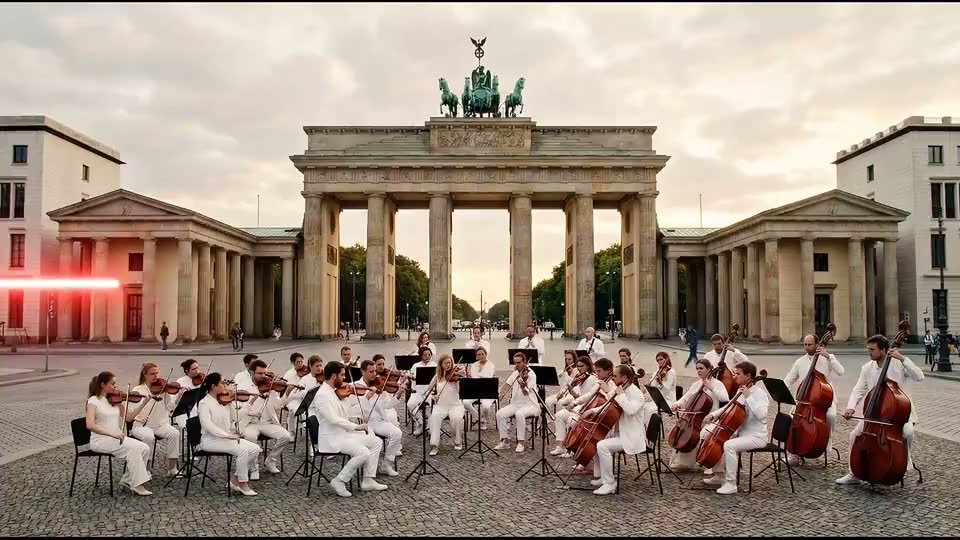
 Made with AI
AI video vs traditional video is rarely a choice between two whole films. It is a choice about which scenes belong to which method, and about what your project really needs. We make AI video, so read this knowing that. It is also why we will tell you plainly when a crew is the better answer.
AI video vs traditional video production, side by side
| AI video | Traditional production | |
|---|---|---|
| What drives budget | Scenes, creative direction, review and edit | Shoot days, crew, equipment, location, talent and permits |
| Speed | No shoot to schedule. Generation and review set the pace, and approvals decide the rest | Booking, travel and weather come first. The shoot day is fixed, and the edit follows it |
| Control | Change a place, the light or a costume at any stage. Exact repeat of a detail is harder | What the lens saw is what you have. Exact on the day, costly to change later |
| Realism | Strong on worlds and atmosphere. Weakest on hands, close talking shots and fine product detail | Real by nature. Real faces, real texture, real moments |
| Versions | New settings, seasons and markets take far less effort than the first film | Each new setting usually means a new shoot |
| Rights | Depends on tool terms and on the law where you run it. Still moving, so ask | Well understood: talent releases, music and location agreements |
| Main risks | Look-alike output, drifting characters, unnatural Arabic, viewers feeling misled if it is not labelled | Weather, availability, overruns on the day, no second chance at a live moment |
Where AI video wins
Places you cannot shoot. A city at a time of day that lasts minutes. A historic street that has gone. A tower that does not exist yet. A crew cannot film any of these, or can do so only at great expense. AI can show them.
Versions. One idea, many settings. A season, a market, a format or a dialect. Once the look and the characters are set, a new version is a smaller job than the first film. This is the clearest structural advantage AI has. It is also why teams running many markets should price the full set of versions, not one film.
Seeing an idea before you fund it. Style frames and test scenes let a marketing team, a CEO and a client all look at the same picture. Disagreements appear early, when they are small. On a shoot, some of them appear on the day.
Scale that would otherwise be out of reach. Crowds, period sets, weather and big landscapes are lines that grow fast on a shoot. With AI, they grow more slowly.
Where a crew wins
Real people saying real things. Founders, customers and employees. We recommend filming them. A real voice on camera carries weight no generated face can match, and an AI person should never be presented as a real testimonial.
Exact product. Texture, packaging, fit and small print have to match the shelf. AI can place a real product in a generated world, but if the product detail is the whole film, a lens is the safer tool.
Live moments. An event, a match, a launch. The truth of it is the point. Nothing replaces being there.
Long talking pieces. Interviews, training and presenter-led films are often simpler and more natural with a camera and a good sound recordist. If a project looks like this, AI may add little. A good video production company with a crew will serve you well.
We do not run full crew jobs. Live action comes into our work as an element inside an AI film. So if your project has no AI scene in it, hire a crew.
Where the budgets overlap
AI vs traditional production cost is the question most people arrive with. The common claim is that AI is always far less. It is not, and we have seen no solid source for the percentage savings often quoted, so we do not use one.
Published crew figures for simple Saudi work overlap with AI ranges at the low end. A straightforward brand film, shot well by a small local crew with one location, can sit level with an AI film of similar length. That is the plain reading of what sellers publish on both sides.
The gap tends to open under these conditions:
- The direction is cinematic, and a shoot would need big sets or many locations.
- The film needs places that cannot be filmed at all.
- There are many versions, languages or markets.
- The same world has to return across a series.
The gap tends to close, or even reverse, under these:
- The film is simple, with one location and a real person talking.
- The product detail is exact and fills the frame.
- The AI version would need many lip-sync shots and recurring characters.
So compare by project, not by method. Build the same brief both ways in the budget calculator, then ask a crew for the same scope.
Hybrid: AI and live action in one film
Many good films are not one or the other. A filmed product inside a generated world. A real founder cut with AI scenes that show where the company is going. Real footage of an event, opened and closed with AI scenes.
Hybrid costs more than either method at its simplest, because you pay for both sets of work. You also get to spend the shoot only where it earns its place. The risk is the join. Light, colour, lens and motion have to match, or the viewer feels the cut even without knowing why. Ask to see a hybrid film before you commission one. We cover the scene-by-scene method in AI and live action in one film.
How to decide: AI video or a shoot
Take your script and work through these steps.
- List every scene. One line each.
- Mark each one. Must be real, can be generated, or either.
- Count them. If most are must be real, hire a crew. If most can be generated, go AI. If it is mixed, go hybrid.
- Price the either scenes both ways. This is where the real saving or waste is hiding.
- Count your versions. One film favours neither side. Ten versions favour AI.
- Check your rights and risk. Who appears, where it runs and what your legal team needs.
- Decide how you will label it. Viewers should not have to guess. Every AI film we make is labelled, with one line: Made with AI. Directed by people.
Then look at finished work, not at claims. Watch a full film by anyone you are considering, with the sound on and on a large screen. Faces, hands and Arabic are where weak AI video shows. You can start with our AI video production work and judge it the same way.
AI video vs traditional video questions
Is AI video lower quality than a traditional shoot?
It can be, and it does not have to be. Quality follows direction, review and edit. Weak AI video and weak crew work are both easy to find. Judge finished films, not the method.
Can AI video replace a camera crew?
For some scenes, yes. For real people, live moments and exact product close-ups, we recommend filming. Many projects need a little of both.
Do viewers mind AI video?
It depends on the film and on honesty. Showing a generated person as a real customer invites trouble. A clearly labelled AI world is a creative choice. Test with your audience when the stakes are high.